

Why your eero extender deserves a pep talk (and this guide)
You know that feeling when you’re trying to watch your favorite show, and it freezes? Or you’re in the middle of a video call, and suddenly you look like a robot?

It’s like your internet connection is playing a prank on you! Sometimes, your home Wi-Fi just doesn’t seem to reach every corner, leaving you stuck in a "dead zone" where the internet goes to nap. This can be super frustrating, especially when you have an [eero extender] that you expect to make everything perfect.
Think of your [eero extender] like a helpful friend who’s trying their best, but sometimes needs a little guidance. Maybe it’s not set up just right, or it’s placed in a spot that makes it hard to send out a strong signal. Even with all the cool tech coming out in 2026, like new projects from big companies, our home networks can still have their funny moments. For example, the Annual Report from early 2026 shows how quickly things are changing, but everyday Wi-Fi hiccups remain. It’s easy to get stressed when your internet isn’t working as it should, but don’t worry. We’ve all been there, dealing with those funny wifi disasters that prove your router has a sense of humor.
This guide is like a friendly pep talk for your internet setup. We’ll walk through simple ways to make your [eero extender] work better, so you can enjoy smooth internet everywhere in your home.
We’ll cover common issues and easy fixes for your [eero extender], and even touch on how other systems like [google wifi mesh], [tp-link ac1200 wifi extender], or even a [cox wifi extender] might run into similar snags. Our goal is to take away the tech headache and put a smile back on your face. Ready to give your Wi-Fi the boost it needs?
1) When your eero extender thinks it’s a houseplant (no signal, just vibes)
Sometimes your eero extender seems to just sit there, looking pretty, but not actually doing its job. It’s like it’s pretending to be a houseplant, just giving off good "vibes" instead of good Wi-Fi! You might wonder if it’s even working. Don’t worry, we can figure this out together.

First, let’s check the really easy stuff. Is your [eero extender] actually plugged into an electrical outlet? It sounds simple, but sometimes a loose plug is all it takes to make your extender act like it’s on vacation. Make sure the plug is pushed all the way in.
Next, take a look at the light on your [eero extender]. What color is it, or is it off completely? A solid blue light is usually a good sign. It means your extender is connected and happy. If the light is off, red, or blinking in a strange way, that tells us something is wrong. Just like how schools provide a Student Handbook | Within the Ivy – Stephens College to help students, your eero’s light is trying to tell you what’s happening. If you’re unsure, your eero app can often explain what the light colors mean.
Another simple step is to make sure your [eero extender] is not too far away from your main eero router. Think of it like playing a game of "telephone." If the first person whispers too softly, the last person won’t hear anything. The extender needs to be close enough to hear the main router clearly to repeat the signal strongly. This advice works for all kinds of Wi-Fi helpers, whether you have an [eero extender], a [google wifi mesh] system, a [tp-link ac1200 wifi extender], or even a [cox wifi extender].
If you’ve checked the plug and the light, and it’s still not working, sometimes just restarting your [eero extender] can fix things. Unplug it from the wall, wait about 30 seconds, then plug it back in. It’s like giving it a fresh start to wake up its Wi-Fi brain. These small steps can really help you fix wifi dead zones with these 10 tips for a stronger signal.
2) The ‘ghost devices’ mystery: devices that refuse to connect
Alright, so you’ve checked your eero extender and it seems to be awake and happy. But now, your favorite tablet or smart device just won’t connect. It’s like your Wi-Fi network has ghost devices that appear but then disappear from your list of available connections, or maybe they just refuse to join the party! This can be super annoying, but we have some tricks to try.
First, let’s look at the simple stuff. Are you sure you’re trying to connect to the right Wi-Fi name (SSID)? It’s easy to accidentally click on a neighbor’s network. And what about the password? Even one tiny typo in your Wi-Fi password will stop your device from connecting. Double-check that you’ve typed it exactly right, paying attention to big and small letters. Sometimes, just deleting the network from your device’s saved list and trying to add it again can help.
Next, think about the device itself. Is its Wi-Fi turned on? This sounds silly, but sometimes a quick toggle off and on again is all it takes. Also, make sure your device isn’t set to "airplane mode," as this turns off all wireless connections. Sometimes, older devices or certain smart home gadgets have trouble connecting to a mesh network like an eero extender or a google wifi mesh system. When an eero network has trouble, it could be due to wrong settings or network problems according to Astound. Checking your device settings is a good move to prevent issues like an eero Keeps Going Offline/Reboots (Solved ).

One tricky part can be Wi-Fi "bands": 2.4 GHz and 5 GHz. Think of these as different lanes on a highway. The 2.4 GHz lane goes a long way but is slower. The 5 GHz lane is super fast but doesn’t reach as far. Your eero extender, just like a tp-link ac1200 wifi extender or a cox wifi extender, usually tries to pick the best lane for your device. But some devices, especially older ones, might only work on the 2.4 GHz lane. If your device isn’t connecting, look in its Wi-Fi settings to see if you can pick a specific band. Often, setting it to "auto" works best, but sometimes a manual choice is needed. If you find your devices connect but the signal is still weak, consider exploring wifi 7 mesh router upgrades that end buffering and bring the laughs for a more powerful and reliable connection.
3) Signal drops during emotional monologues (WiFi that only quits when you need it socially)
Okay, so your devices are actually connecting now, which is great! But imagine this: you’re telling a really important story, or maybe having a serious video chat with family, and then BAM! Your Wi-Fi signal just… disappears. It’s like your eero extender or google wifi mesh system has a dramatic flair, timing its outages for your most heartfelt moments. Super frustrating, right? This isn’t about devices not connecting, but about your Wi-Fi dropping out when you need it most.
When your Wi-Fi keeps cutting out, it’s often a sign of instability. This can happen with any system, whether it’s an eero extender, a tp-link ac1200 wifi extender, or a cox wifi extender. The first step is to figure out if these drops are random or if they follow a pattern.
How to Check if Your Wi-Fi Is Truly Stable
- Run a Network Health Check: Many modern Wi-Fi systems, including
eero, have helpful apps that let you check on your network’s health. This can tell you if there are any big problems or if your internet is working well from their side. You can often check your network health check feature through the eero App. - Test Your Speed (Throughput Test): Use a speed test website or app to check your internet speed at different times of the day. Do this when you notice drops. If your speed is fine right after a drop but then dips again, it tells you something is unstable. You want to see steady speeds, not big ups and downs.
- Watch for Patterns: Does your Wi-Fi always drop around the same time? Maybe when the microwave is on, or when a smart appliance starts up? Sometimes other devices can cause interference. Old baby monitors, cordless phones, or even your neighbor’s Wi-Fi can get in the way.
- Check Your
eero Extender(or other system) Placement: Just like we talked about earlier, where youreero extenderor other mesh points sit in your home matters. If a drop happens a lot in one spot, try moving theeerodevice closer to where you’re using Wi-Fi. Also, make sure it’s not tucked away in a cabinet or behind a big TV. - Restart Everything: Yes, the classic "turn it off and on again" works a lot. Unplug your main router and all your
eero extenderunits for about a minute. Then plug them back in, starting with the main one connected to your internet, and wait for them all to turn back on. This can often clear up small glitches.
If your Wi-Fi keeps acting like a drama queen, it might be time to look deeper into the problem. Sometimes, Wi-Fi can be so tricky it leads to some truly funny wifi disasters that prove your router has a sense of humor. After dealing with all these tech headaches, you might need a good laugh to shake it off. Why not try an adventure that’s guaranteed to make you smile?
A ridiculous sci-fi adventure with heart, wit, and chaos. Laugh First Today.
Sometimes, your Wi-Fi isn’t just dropping out, it’s just plain slow. It’s like your eero extender is trying its best, but everyone else on the block is also trying their best to watch cat videos in 4K. Your internet might feel like it’s being judged and found wanting, especially when your neighbor’s streaming a full-blown cat opera in high definition, while your movie keeps stopping to buffer. This isn’t about connecting or dropping, but about your internet speed feeling sluggish, like it’s trudging through mud.
Why Your Wi-Fi Might Be Slow (and What to Do)
Slow Wi-Fi often happens because of too much traffic, either in your own home or from nearby networks. Think of it like a busy highway; if everyone tries to drive on it at once, things slow down.
- Check for Channel Congestion: Your Wi-Fi network uses certain "channels" to send data. If too many networks nearby (like your neighbor’s
google wifi meshorcox wifi extender) are using the same channel, it’s like a crowded radio station. This can make your internet slow. Many Wi-Fi systems, includingeero, have apps that let you see which channels are busy and even switch to a less crowded one. Learning how to manually set WiFi channels can make a big difference for network performance. - Run Speed Tests Often: You already know how to do a speed test from earlier. But for slow speeds, do it multiple times a day. Check your speed when you first notice it’s slow. If your speeds are consistently low, especially during certain times, it could point to a bigger issue.
- Think About Quality of Service (QoS): Some routers and mesh systems, like
eeroandtp-link ac1200 wifi extendermodels, have a feature called QoS. This lets you tell your network which devices or apps are most important. For example, you can tell it to give more speed to your video calls than to a game download. This can help make sure your most important tasks stay fast even when other things are happening. - Consider Your
eero ExtenderPlacement Again: If youreero extenderor other Wi-Fi points are too far from your main router or from where you use the internet most, your speed will suffer. Try moving them closer to the center of your activity. Sometimes, moving a device just a few feet can greatly improve your signal and speed, fixing WiFi dead zones with these 10 tips for a stronger signal. - Look into a Mesh Network Upgrade: If you have many devices and still struggle with slow spots, especially in a larger home, a mesh Wi-Fi system might be a better fit. These systems use several units that work together to cover your whole home with strong, fast Wi-Fi, which can really help in optimizing Wi-Fi performance in high-density areas or busy homes.
After tackling slow internet, sometimes the first clue to a Wi-Fi problem comes from the little lights on your devices. It’s like your eero extender or google wifi mesh system is trying to tell you something with its own special "mood lighting." If you know how to read these signals, you can figure out what’s wrong, almost like reading tarot cards for your internet.
Here’s a quick guide to what those colors might mean for your eero extender and similar devices:
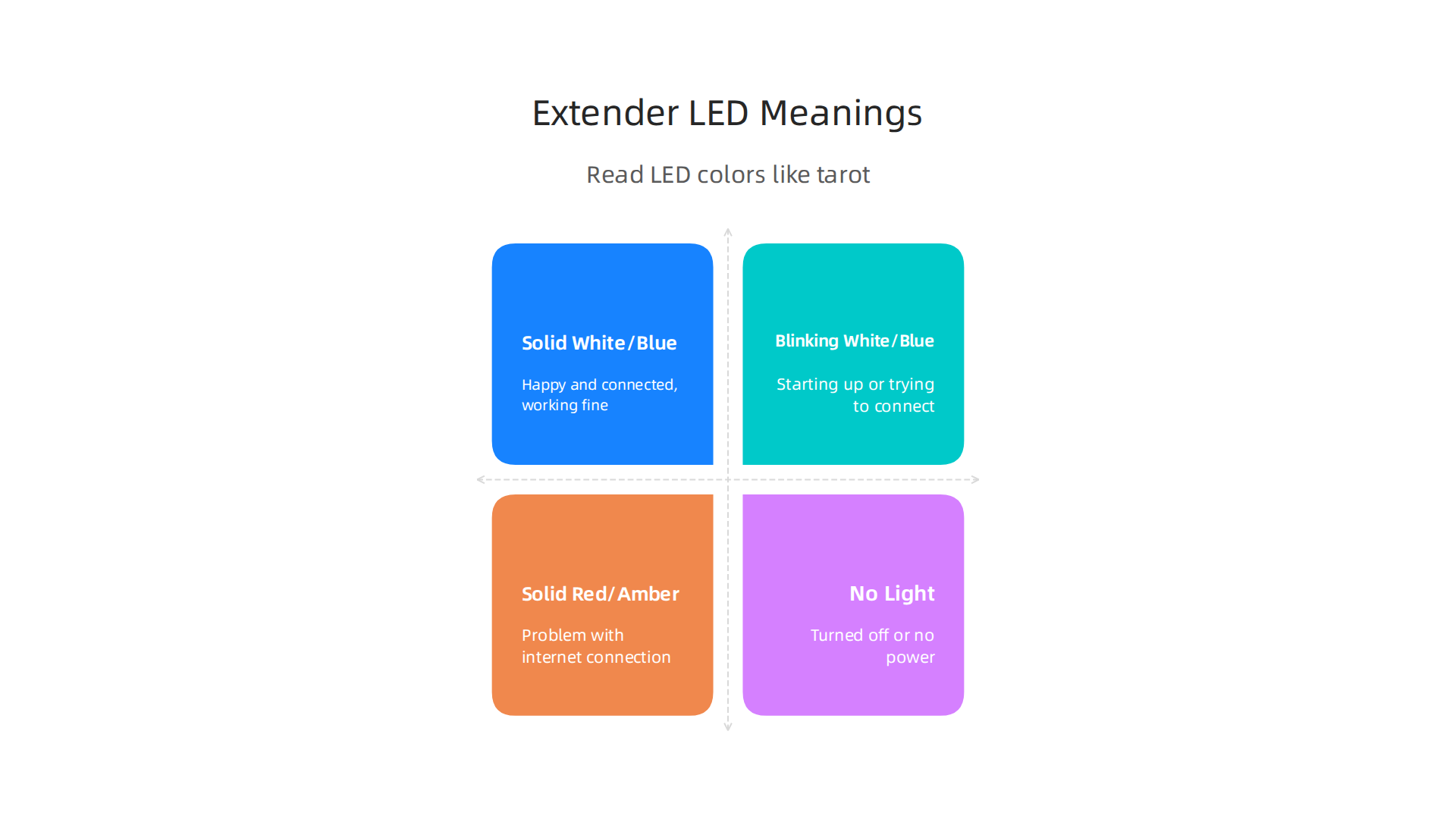
- Solid White or Blue: Good news! A steady white or blue light usually means your
eero extenderis happy and connected. It’s working just fine, sending out Wi-Fi signals. Other systems, like atp-link ac1200 wifi extender, might also use a solid green or blue for good health. This means your Wi-Fi device is running smoothly, as experts often test for when ranking the Best WiFi Routers of 2026, Tested by Our Experts. - Blinking White or Blue: This often means your device is starting up or trying to connect. If it keeps blinking for a long time, it might be stuck. Try unplugging your
eero extenderfor a minute and plugging it back in. - Solid Red (or Amber/Orange): Uh oh. A solid red light usually means there’s a problem with your internet connection. Your
eero extendermight not be getting internet from your modem or main router. Forcox wifi extenderusers, this might also show up as a solid orange. You might need to check your main internet connection or reboot your modem and router first. - No Light at All: If there’s no light on your
eero extender, it could be turned off, or it might not be getting power. Make sure it’s plugged in correctly and the outlet is working.
Remember, these colors can be a bit different depending on the brand. For example, a google wifi mesh system might have slightly different light patterns than an eero extender. Always check your device’s app or manual for the exact meanings. But generally, knowing these basic signs can help you quickly spot an issue and get your internet back on track.
If your portable extender seems to be having trouble even after checking its lights, finding a portable Wi-Fi extender that fixes buffering and saves every punchline can be a great way to ensure you’re always connected.
It’s amazing how much these little lights can tell us. They’re like tiny traffic lights for your internet, guiding you to a solution. Dealing with Wi-Fi troubles can be frustrating, but a good laugh always helps. Meet a book series made for readers who like funny and thoughtful.
6) Firmware updates: the extender’s midlife crisis (it needs a software hug)
Think of your Wi-Fi extender like a smart little helper that sometimes needs a pep talk and new ideas. Those ideas come in the form of "firmware updates." Firmware is like the brain of your eero extender or google wifi mesh system. It’s the software that tells it how to work. Just like people, even the best devices need fresh knowledge to stay sharp and secure.
Why Firmware Updates Are Your Wi-Fi’s Best Friend
Keeping your device’s firmware up to date is super important. It’s like giving your tp-link ac1200 wifi extender a special vitamin boost. These updates can:
- Make it faster: New software can help your extender work better and share Wi-Fi more smoothly.
- Fix little bugs: Sometimes, tiny mistakes or glitches are found in the software. Updates fix these, so your device runs without hiccups.
- Keep it safe: Like putting a stronger lock on your door, updates add new security features to protect your network from bad stuff online.
- Add new tricks: Your
cox wifi extendermight even learn new features with an update.
Experts often suggest regular firmware updates as a top tip for keeping your Wi-Fi running well and performing better over time 5 Top Tips to Improve WiFi Performance for a Stable Network. Neglecting these updates can even make your smart home network less secure Why your consumer-grade network won’t cut it for a smart home.
How to Give Your Extender a Software Hug
Updating firmware might sound tricky, but it’s usually very easy. Most modern Wi-Fi extenders, including your eero extender and google wifi mesh units, let you do it right from their app on your phone.
Here are the simple steps:
- Open the App: Find the app for your Wi-Fi extender on your phone or tablet.
- Look for Settings: In the app, tap on "Settings" or "Advanced Settings."
- Find "Firmware" or "Update": You’ll usually see an option like "Firmware Update" or "Check for Updates."
- Click to Update: If there’s a new update, the app will ask you if you want to install it. Tap "Yes!"
- Be Patient: Your extender might restart during the update. Don’t unplug it or turn it off while it’s updating. It usually takes a few minutes.
After the update, your eero extender should be running with the latest and greatest software, helping your Wi-Fi be more reliable and secure.

If you’re still running into slow speeds or dead zones, checking the firmware is a great step toward getting your connection back on track, and can often improve your overall network performance. For more ideas on boosting your home’s signal, check out these tips to fix Wi-Fi dead zones with these 10 tips for a stronger signal.
Dealing with tech problems can sometimes feel like a wild adventure, full of twists and turns. But remember, a good laugh makes everything better.
Laugh First Today
Dealing with tech problems can sometimes feel like a wild adventure, full of twists and turns. But remember, a good laugh makes everything better. Sometimes, the fix for a slow eero extender or google wifi mesh isn’t a complex update. It’s much simpler, and a little bit funny.
7) Placement problems: extenders that hide in plain sight
Have you ever looked around your home and realized your Wi-Fi extender is playing hide-and-seek? It’s often tucked away behind a big curtain, inside a closed cabinet, or even hidden under a pile of books. We want our gadgets to blend in, but for a Wi-Fi extender, hiding is the worst thing it can do!
Imagine trying to shout across a room with a blanket over your head. That’s kind of what your tp-link ac1200 wifi extender is doing when it’s hidden away. Walls, metal objects, big furniture, and even other electronics can block the Wi-Fi signal. When your cox wifi extender is hidden, it can’t send or receive signals very well, which means slower internet for you. Devices placed in corners, low spots, or inside cabinets can really cut down on how far your Wi-Fi reaches [How to Extend WiFi Coverage: Ultimate Troubleshooting Guide
](https://www.netgear.com/hub/wifi/extenders/how-to-extend-home-wifi-coverage/).
Finding Your Extender’s Happy Place
Finding the best spot for your Wi-Fi extender is like finding the perfect seat in a movie theater. It makes all the difference! The main idea is to put your extender somewhere it can easily "see" both your main Wi-Fi router and the areas in your home where you need better Wi-Fi.
Experts suggest placing your extender about halfway between your main router and the spot where your Wi-Fi signal gets weak How can I find the best location for my WiFi range extender. Think of it as a helpful middleman. It needs to be close enough to your router to get a strong signal, but far enough to share that signal with the areas that need it most Can the Right Placement Make a Difference?.
Here are some quick tips to find the sweet spot:
- Go High and Open: Place your extender on a shelf, table, or wall mount. Make sure it’s not blocked by anything big.
- Keep it Clear: Try to keep it away from thick walls, metal objects like filing cabinets, and appliances like microwaves or cordless phones, as these can cause interference.
- Run a Quick Test: Move your
eero extenderto a new spot and then check your Wi-Fi speed in the "dead zone." If it’s better, you’ve found a good spot!
Sometimes, all it takes is a little move to get your Wi-Fi working its best. If you’ve been having trouble with your connection, don’t overlook the simple power of good placement. And if you’ve had some funny moments trying to get your Wi-Fi to cooperate, you’re not alone! Check out some stories of Funny wifi disasters that prove your router has a sense of humor.
Sometimes, no matter how much you move your Wi-Fi extender around, the internet still plays tricks on you. You might have tried everything: rebooting the eero extender, checking cables, and even talking nicely to your google wifi mesh system. When all else fails, there’s one last dramatic step many people think about: the factory reset. It feels a bit like pressing the "big red button" for your Wi-Fi, doesn’t it?
The Big Red Button: When Factory Reset Feels Dramatic
A factory reset is when you make your Wi-Fi extender forget all its settings and go back to how it was when you first took it out of the box. For your tp-link ac1200 wifi extender or cox wifi extender, this can feel like a huge deal. It’s like telling your favorite coffee shop to forget your usual order and starting all over again. But sometimes, it’s the only way to fix stubborn problems.
Before you take this big step, make sure you’ve tried simpler fixes, like those 10 tips for a stronger signal. Sometimes, a full reset isn’t needed Fix Wifi Dead Zones With These 10 Tips For A Stronger Signal.
Here’s a checklist to follow before you hit that reset button:
- Write Down Your Wi-Fi Names and Passwords: Your main router’s Wi-Fi name (SSID) and password are super important. Your extender needs these to connect again.
- Check Your Extender’s Default Login: Find the small sticker on your extender or in its manual. It will have a default Wi-Fi name and password, or a special web address to set it up.
- Try Simple Restarts First: Turn your extender off, wait 30 seconds, and turn it back on. Do the same for your main router. Sometimes this is all it takes!
- Look for Firmware Updates: Just like your phone gets updates, your extender might need one too. Check the maker’s website to see if there’s a new version that can fix bugs How to Extend Wi-Fi Range: 12 Ways to Boost Your Signal.
Resetting and Reconfiguring Safely
If you’ve done all that and your Wi-Fi is still acting up, then a factory reset might be the answer. Most extenders have a tiny button, often in a small hole, that you need to press and hold for about 10 seconds. You might need a paperclip or a pen to push it.
Once you reset it, your extender will go back to its factory settings. This means you’ll have to set it up again as if it were brand new. You’ll connect to its default Wi-Fi network, open a web browser, and follow the setup wizard. It’s usually a step-by-step guide that helps your extender find your main Wi-Fi network and start boosting it again. Take your time, follow the instructions carefully, and soon your Wi-Fi should be back in business!
Even after a factory reset, your Wi-Fi might still be playing hard to get. It’s like your eero extender is giving you the silent treatment. Don’t worry! This doesn’t mean your internet is beyond hope. There are still a few clever tricks you can try to find out why your Wi-Fi is sulking. These are like being a super detective for your home network, but without the panic.
Becoming a Wi-Fi Detective: Deeper Checks
Sometimes, the problem isn’t a simple fix. It’s hidden deeper. Here’s how to dig a little further:
-
Check the Wi-Fi’s "Diary" (Logs): Most modern Wi-Fi systems, like your
google wifi meshor aneero extender, have an app. Inside the app, you can often find something called "logs" or "system history." This is like a diary that tells you what your Wi-Fi has been doing. It might show if your internet connection keeps dropping or if an extender is losing its connection. For example, someeerousers found their system was dropping connection after certain updates, and checking logs could help you see if you have a similar issue EERO v6.0.4 dropping internet connection – Discussion Topics. -
Look at Your Mesh Map: If you have a mesh Wi-Fi system, like a
google wifi meshor aneero extendersetup, your app usually shows a map of all your devices. Check if all your extenders are connected strongly to the main router or to each other. If yourtp-link ac1200 wifi extenderis showing a weak connection on the map, it might need to move closer to the main router or another stronger mesh point. Understanding how your different Wi-Fi parts work together can help you find dead spots or weak links in your home. You can learn more about picking the right setup for your home to avoid these issues in the first place Find The Best Mesh Wifi Router For Your Home Without The Headache. -
Scan for Interference: Believe it or not, other things in your home can mess with your Wi-Fi signal. Things like microwaves, cordless phones, baby monitors, or even your neighbor’s Wi-Fi can cause trouble. Some Wi-Fi apps or special tools can "scan" your area to see what’s interfering. If you find a lot of interference, you might need to change your Wi-Fi channel in your router settings or move your
cox wifi extenderaway from those problem gadgets. -
When to Call for Help: If you’ve tried all these steps and your Wi-Fi is still misbehaving, it’s okay to ask for help. Your internet service provider (like Cox for a
cox wifi extender) or the company that made your Wi-Fi system (likeeerosupport) can often look at your system from their end. They have special tools to see what’s going on and can help you fix it or send out a technician if needed.
Even when tech troubles pop up, finding a moment to smile can make a difference.
Ready for an adventure that guarantees some laughs? Dive into "A Ridiculous Sci-Fi Adventure with Heart, Wit, and Chaos." Get your copy today and Laugh First Today.
Summary
This friendly how‑to guides you through common problems with an eero extender and other mesh or extender systems, from no signal and devices that won’t join the network to intermittent drops and slow speeds. You’ll learn quick checks (power, lights, proximity), simple fixes (restarts, forgetting and re-adding networks), and practical placement tips that usually restore coverage fast. The article explains what the extender’s light colors mean, how to run basic throughput and health checks, and when interference or channel congestion might be slowing you down. It also covers firmware updates, safe factory resets, and deeper diagnostics like reading logs and checking the mesh map so you can find weak links. Throughout, the guide compares similar gear (Google Wifi, TP‑Link, Cox) and points to when a mesh upgrade or portable hotspot makes sense. After reading, you’ll be able to diagnose common extender issues, apply targeted fixes, and decide if an upgrade or tech support call is the next best step.